
How AI Changes the Geometry of Flow Zone
Flow theory links challenge and skill. AI may widen that balance by increasing effective capability—and move the frontier toward harder work.
Also available in Español
AI may not only make flow easier to reach. It may expand the range of challenges we can handle—and move that range toward more demanding work.
There are moments when work seems to change character.
You stop looking at the clock. Your attention narrows. The next step feels clear. The task is demanding enough to require concentration, but not so difficult that it becomes paralyzing. Progress starts to feel rewarding in itself.
Psychologist Mihaly Csikszentmihalyi gave this experience a name: flow.
His research on intrinsically rewarding activities developed through the 1970s, including Beyond Boredom and Anxiety in 1975, and the idea became widely known through his 1990 book Flow: The Psychology of Optimal Experience. [1][2]
Flow describes a state of deep involvement in an activity: attention becomes highly focused, self-consciousness can recede, our perception of time may change, and the activity itself can become rewarding. [3]
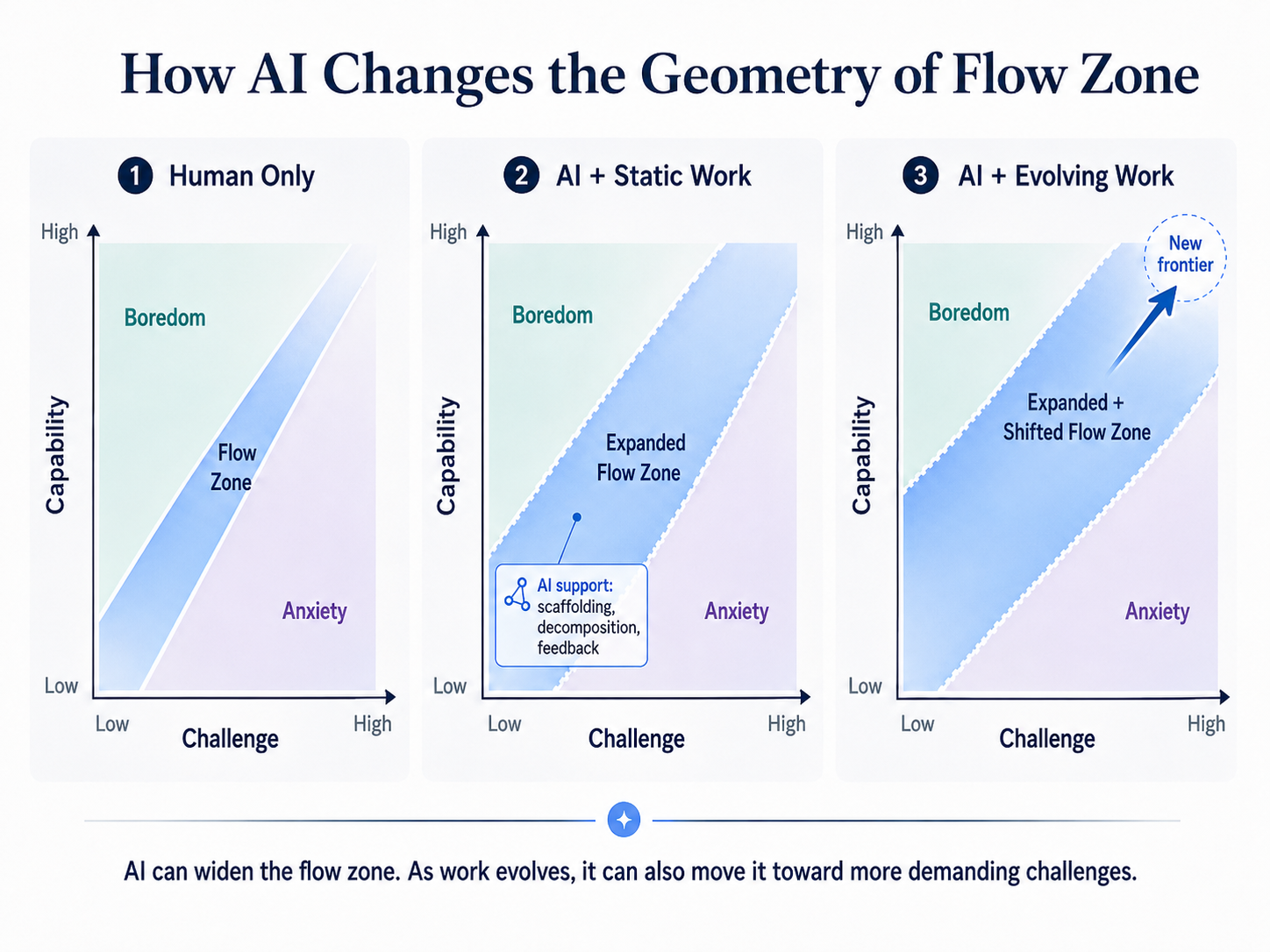
One of the best-known representations of the concept places skill on one axis and challenge on the other.
When challenge is too low relative to skill, boredom becomes more likely. When challenge greatly exceeds skill, anxiety or frustration can appear. Between those extremes lies the familiar flow zone: the region where what the task demands and what the person can do are sufficiently well matched.
The diagram is a simplification of a richer theory. Challenge–skill balance is not the only condition associated with flow; clear goals, feedback and a sense of control matter too. Research nevertheless supports challenge–skill balance as an important contributor to the experience. [3][4]
And that raises an interesting question for the AI era:
What happens when our effective capability can change while we are performing the task?
AI changes the capability side of the equation
Without external support, we approach a challenge with our current knowledge, skills, memory, tools and available time.
AI changes that configuration.
An AI system can explain an unfamiliar concept, retrieve and organize information, propose alternatives, generate a first draft, review code, identify errors or provide feedback while the work is still happening.
The person has not instantly acquired all those abilities as permanent individual skills.
But their effective capability while working has changed.
AI can also act on the challenge itself. A problem that initially feels opaque can be transformed into a sequence of understandable actions:
That matters because flow is not only about how capable we are. It is about the relationship between our capabilities and the challenge in front of us.
AI may widen the flow zone
This leads to the central hypothesis:
AI can widen the flow zone by increasing the range of challenges that remain workable relative to our effective capabilities.
There is already some research compatible with this idea.
A 2025 study specifically examined flow in a ChatGPT-based learning environment. The researchers found that the environment supported several antecedents of flow, and that skill–challenge balance was particularly influential in participants' reported flow experiences. The study is narrow and does not establish a universal theory of AI-assisted flow, but it directly connects generative AI with conditions associated with flow. [5]
More broadly, experiments on professional work show that generative AI can materially change what the same person can accomplish within a given period. In one experiment with 453 college-educated professionals performing writing tasks, ChatGPT reduced average completion time by 40% while increasing output quality by 18%. [6]
Neither result proves that AI automatically produces flow.
But they support the mechanism underneath the hypothesis: AI can alter effective Human capability while a task is being performed.
That effect has two consequences.
For work whose scope remains broadly stable, a larger portion of the task can move into a manageable range. Blocking points become easier to overcome, feedback can arrive faster, and the person may spend more of the working session operating inside the challenge–capability balance rather than repeatedly falling outside it.
But work rarely remains completely fixed once capability increases.
And that produces the more interesting effect.
The flow zone can move
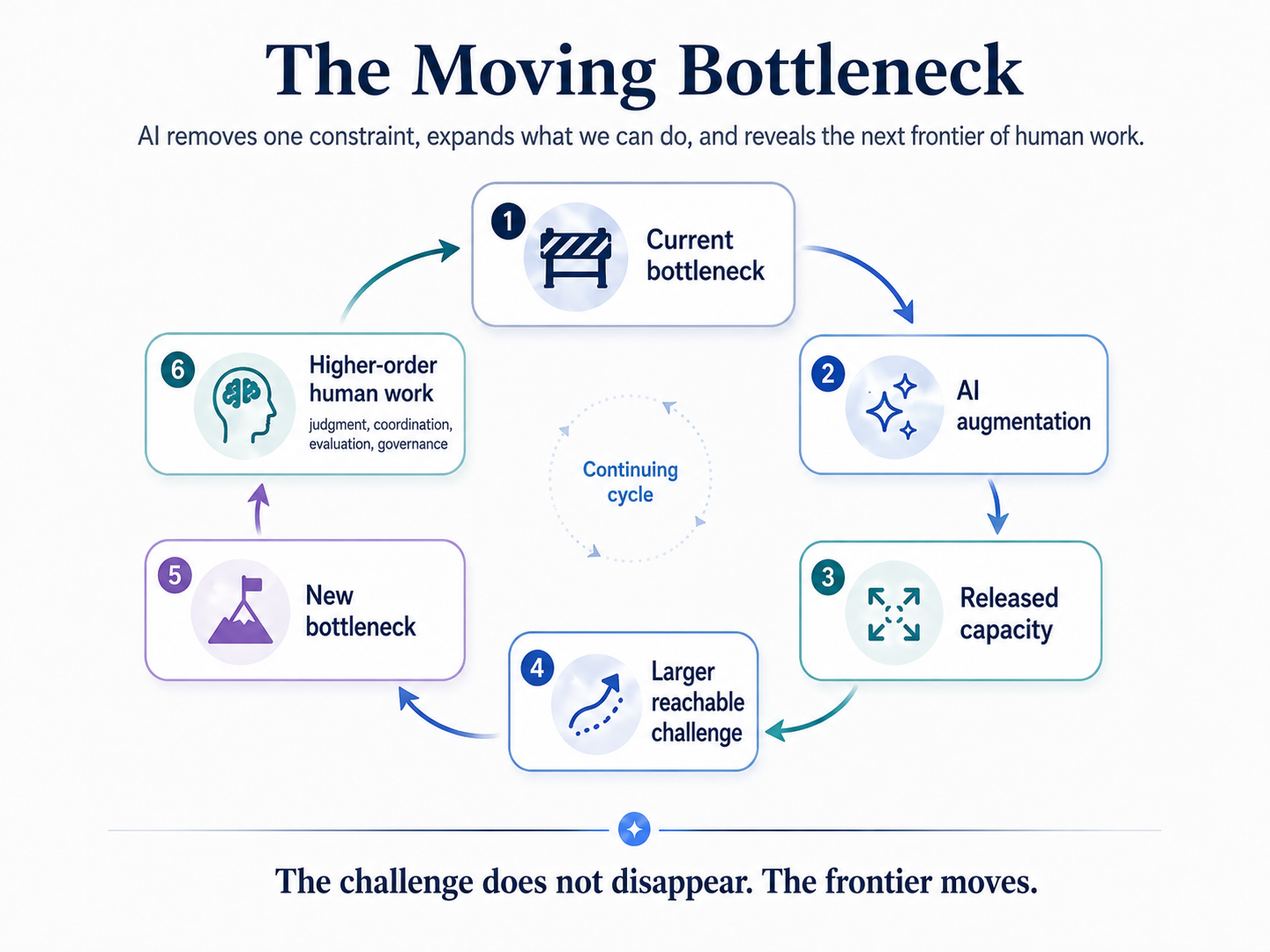
When one bottleneck disappears, another usually becomes visible.
If information gathering becomes easier, deciding which information matters can become the new challenge.
If producing an initial analysis becomes easy, comparing alternatives and deciding between them becomes more important.
If implementation accelerates, architecture may become the constraint.
If a person can suddenly coordinate far more productive output, prioritization, evaluation and governance become harder and more consequential.
So AI does not necessarily eliminate meaningful challenge.
It can move the challenge upward.
This resembles what happens when an individual gains capable collaborators. A person working alone has one productive frontier. Add a team and that frontier expands—but the person's work also changes. Less attention may go into performing every individual task, while more goes into coordinating, reviewing, integrating and deciding.
AI can create a similar effect, except that this additional productive capacity can increasingly be available to an individual, continuously and on demand.
This gives us a better interpretation of the flow diagram:
AI may expand the flow zone, while growing Human–AI capability can progressively shift that zone toward more complex challenges.
The initial benefit does not disappear when the next challenge appears.
The person has moved to a different frontier.
The moving bottleneck
The process can be represented as a recurring cycle:
This is why delegating lower-level work to AI should not automatically be interpreted as eliminating Human thought.
It may eliminate the need to make some low-value micro-decisions.
But if the Human remains responsible for the work, increased productive capacity can create a need for more judgment at a higher level: evaluating more information, coordinating more activity, choosing among more alternatives and making decisions with greater consequences.
The Human contribution changes.
The challenge changes with it.
Research on knowledge workers using GPT-4 reinforces another important part of this picture: AI capability is not uniform. In a large field experiment, performance improved substantially on tasks inside the model's capability frontier, while results were worse on a task outside it. The researchers described this uneven boundary as a "jagged technological frontier." [7]
The emerging Human–AI flow zone is therefore unlikely to be perfectly smooth or permanent.
It depends on the person, the task, the AI system and the frontier of what that combination can reliably accomplish.
A moving frontier of meaningful work
The original flow model helps explain why some activities become deeply engaging: they place us in the right relationship to challenge.
AI may now be changing that relationship.
It can reduce friction, shorten feedback loops, make previously inaccessible knowledge usable and help transform large problems into manageable steps.
That can widen the range of work in which challenge and effective capability remain well matched.
But as our productive capacity increases, the story does not necessarily end with easier work.
We can take on a larger problem.
A broader responsibility.
A more consequential decision.
A higher level of coordination.
And then a new challenge appears.
So perhaps the most interesting effect of AI on flow is not that it makes difficult things easy.
It is that it can make previously unreachable difficulty reachable.
In stable work, AI can widen the flow zone. As work evolves, it can widen it and move it.
The challenge does not disappear.
The frontier moves.
Sources
[1] Mihaly Csikszentmihalyi — Beyond Boredom and Anxiety (1975) — Foundational early work in the development of flow theory.
[2] Mihaly Csikszentmihalyi — Flow: The Psychology of Optimal Experience (1990) — The book that brought the concept of flow to a much broader audience.
[3] Jeanne Nakamura & Mihaly Csikszentmihalyi — “The Concept of Flow,” Handbook of Positive Psychology — Academic overview of flow, complete absorption, and the development of the model.
[4] Carlton J. Fong, Diana J. Zaleski & Jennifer Kay Leach — “The Challenge–Skill Balance and Antecedents of Flow: A Meta-Analytic Investigation” — Meta-analysis of 28 studies examining challenge–skill balance and other flow antecedents.
[5] Ruofei Zhang, Di Zou, Gary Cheng & Haoran Xie — “Flow in ChatGPT-Based Logic Learning and Its Influences on Logic and Self-Efficacy in English Argumentative Writing” — Directly examines flow and its antecedents in a ChatGPT-based learning environment.
[6] Shakked Noy & Whitney Zhang — “Experimental Evidence on the Productivity Effects of Generative Artificial Intelligence” — Controlled experiment showing increased productivity and quality on professional writing tasks with ChatGPT.
[7] Fabrizio Dell'Acqua et al. — “Navigating the Jagged Technological Frontier: Field Experimental Evidence of the Effects of Artificial Intelligence on Knowledge Worker Productivity and Quality” — Field experiment examining how AI performance gains vary according to whether tasks fall inside or outside the technology's capability frontier.